 AI Visibility Audit
Free AI Visibility Audit for ChatGPT, Claude, Perplexity and Google AI Overviews
AI Visibility Audit is a free tool that checks whether AI search engines can crawl, understand and cite a web page. Enter a URL and it runs more than 80 live checks in under a minute, scores five pillars out of 100, and writes the exact fixes you need: robots.txt rules, an llms.txt file, JSON-LD structured data and FAQ markup.
- Free, no signup
- 19 AI crawlers tested
- Results in about 30 seconds
- Shareable report link
What is AI visibility?
AI visibility is the likelihood that an AI assistant can reach your page, understand who published it, and quote it when it answers a question. It is the goal of generative engine optimization (GEO), also called answer engine optimization (AEO). Where classic SEO asks how high a page ranks among 10 blue links, GEO asks whether ChatGPT, Claude, Perplexity, Gemini or a Google AI Overview names your business in the single answer the user reads.
An AI answer engine works in three steps: a crawler fetches pages, a retrieval system splits them into passages and picks the most relevant ones, and a large language model writes an answer that cites a handful of sources. Your page can fail at any of the three steps. It can be blocked from crawling, it can be hard to split into clear passages, or it can lack the entity signals that make a model confident enough to name you.
Why local businesses feel the pain first
Local search is where AI answers hurt most, because questions such as “best emergency plumber near me” or “which dentist is open on Saturday” now get a direct recommendation instead of a list. Google began showing AI Overviews in US search results in May 2024, and assistants like ChatGPT search and Perplexity answer local questions with two or three named businesses. If yours is not one of them, the click never happens.
Most local AI visibility problems come from 4 fixable causes: a firewall that blocks AI crawlers, opening hours and prices hidden in images or JavaScript, no LocalBusiness or Organization structured data, and pages that never state plainly what the business does, where, and for whom. Each one usually takes an afternoon to fix, and the audit finds all of them and tells you exactly what to change.
What does the AI Visibility Audit check?
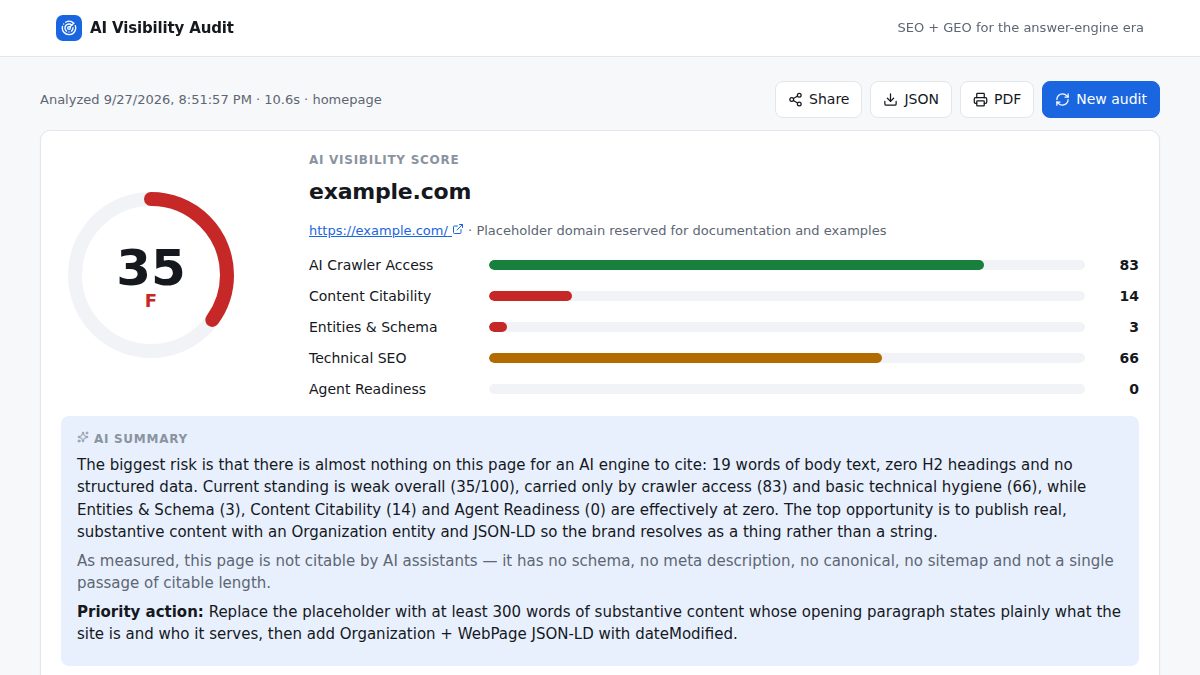
The audit groups more than 80 checks into 5 pillars. Each pillar is scored from 0 to 100, and the overall AI visibility score is their weighted average, so the pillars that most often decide whether an AI system can cite you carry the most weight. Crawler access and content citability count for half of the total.
| Pillar | Weight | What it checks |
|---|---|---|
| AI Crawler Access | 25% | robots.txt rules for 19 AI crawlers, a live firewall test with AI user-agents, noindex and noai signals, XML sitemap freshness and soft-404 handling. |
| Content Citability | 25% | Answer-first openings, passage-level citability, question headings, fact density, and paragraph sizes that retrieval systems handle well. |
| Entities & Schema | 20% | Organization identity, sameAs and Wikidata grounding, eligibility for 16 Google rich result types, and whether schema matches visible content. |
| Technical SEO | 15% | Titles, meta descriptions, canonical tags, raw versus rendered HTML, Googlebot versus browser content, social cards, images and Core Web Vitals. |
| Agent Readiness | 15% | llms.txt quality, entities.txt, MCP and A2A discovery files, OpenAPI specs, machine-readable pricing and schema.org actions for AI agents. |
How does the audit work?
Every audit runs 5 live steps against the public page, so the results reflect what AI crawlers actually receive today rather than a cached copy or a guess. A typical audit finishes in 10 to 30 seconds, and every result links back to the evidence behind it.
- Fetch the page twice. The audit requests the URL as a normal browser and as Googlebot, then compares the two responses to detect cloaking or dynamic rendering.
- Test every AI crawler. It parses robots.txt with Google’s matching rules for 19 AI crawlers, then sends real requests with AI user-agents to see whether a CDN or firewall blocks them.
- Render the JavaScript. A headless Chromium browser renders the page so the audit can measure how much content only exists after JavaScript runs.
- Score five pillars. More than 80 checks roll up into five weighted pillar scores and one overall AI visibility score from 0 to 100.
- Write the fixes. The report lists findings by severity and effort, and generates a ready-to-paste llms.txt, JSON-LD graph and robots.txt block for AI crawlers.
Search crawlers vs training crawlers: which should you allow?
OpenAI and Anthropic each run 3 separate crawlers: one for search, one for user requests and one for model training, and each one obeys its own robots.txt token. Blocking a training crawler keeps your content out of future models, while blocking a search or user agent removes you from the answers people read today.
| Crawler | Company | Purpose | Recommendation |
|---|---|---|---|
OAI-SearchBot | OpenAI | Search | Allow: powers ChatGPT search results and citations |
ChatGPT-User | OpenAI | User request | Allow: fetches pages when a ChatGPT user asks about them |
GPTBot | OpenAI | Training | Your choice: collects data for training OpenAI models |
Claude-SearchBot | Anthropic | Search | Allow: indexes pages for Claude’s web search |
Claude-User | Anthropic | User request | Allow: fetches pages a Claude user asks about |
ClaudeBot | Anthropic | Training | Your choice: collects data for training Claude models |
PerplexityBot | Perplexity | Search | Allow: builds the index Perplexity answers from |
Googlebot | Search | Allow: required for Google Search and AI Overviews | |
Google-Extended | Training | Your choice: controls use of your content for Gemini model training |
What fixes does the audit generate?
Every report ends with 5 ready-to-paste fixes, generated from what your page already contains, so a developer can ship the most important changes in minutes instead of writing them from scratch. Values the audit cannot know, such as your legal company name, are marked TODO.
- llms.txt: a curated, spec-compliant map of your most important pages for AI assistants and agents.
- JSON-LD @graph: Organization, WebSite and WebPage nodes with sameAs, logo, dates and speakable markup, built from what your page already declares.
- robots.txt AI block: explicit Allow rules for AI search and user agents, with training crawlers kept as a separate, deliberate decision.
- FAQPage markup: generated from question headings already on your page, so visible content and schema stay aligned.
- entities.txt and agent files: starter files for entity disambiguation, MCP discovery and an A2A agent card.
What are the most common AI visibility problems?
These 6 issues appear again and again in audits of business websites, and every one of them can stop an AI assistant from citing a page that ranks well in classic search. Most of them are invisible in a normal browser, which is why they go unnoticed for months.
- A firewall blocks AI crawlers that robots.txt allows. CDN bot protection often returns HTTP 403 to GPTBot, ClaudeBot or PerplexityBot even when robots.txt says Allow, and site owners rarely notice.
- Content only appears after JavaScript runs. Most AI crawlers do not execute JavaScript, so a client-rendered page can look empty to them even when it looks complete in a browser.
- No Organization entity. Without Organization structured data, logo and sameAs links, an AI model has to guess which business a brand name refers to.
- The opening paragraph does not answer anything. AI Overviews and answer engines favour pages whose first 40 to 60 words state the answer directly.
- FAQ content without FAQPage schema. Question-and-answer content is the easiest thing for an AI system to quote, but only if the structure is machine-readable.
- Missing pages return HTTP 200. Soft 404s waste crawl budget and can put thin, duplicate pages into AI indexes.
How is the AI visibility score calculated?
The overall score is the weighted average of the five pillar scores, rounded to a whole number from 0 to 100, and each score maps to a letter grade. Findings are ranked by severity and then by effort, so the first items in a report are the ones that matter most and take the least time.
| Grade | Score |
|---|---|
| A+ | 90–100 |
| A | 80–89 |
| B | 70–79 |
| C | 55–69 |
| D | 40–54 |
| F | 0–39 |
Frequently asked questions
What is an AI visibility audit?
An AI visibility audit is a check of whether AI search engines and assistants can find, understand and cite a web page. This one tests AI crawler access, content structure, entities and structured data, technical SEO and agent readiness, then scores each pillar out of 100 and lists the fixes in priority order.
Is the AI Visibility Audit free?
The AI Visibility Audit is free: it needs no account and has no usage fee. Each visitor can run up to 20 audits per hour, and every report gets a shareable link that stays available so you can send it to a developer, an agency or a client.
How long does an audit take?
A standard audit takes 10 to 30 seconds. Turning on Core Web Vitals adds 20 to 30 seconds because Google PageSpeed Insights loads the page on a simulated phone, and the optional AI summary adds about 15 seconds while Claude writes the narrative.
Which AI crawlers does the audit test?
The audit checks robots.txt rules for 19 AI crawlers, including OAI-SearchBot, ChatGPT-User, GPTBot, Claude-SearchBot, ClaudeBot, PerplexityBot, Googlebot, Bingbot, Applebot-Extended, Amazonbot and CCBot. It also sends live requests as GPTBot, ClaudeBot, PerplexityBot and Googlebot to catch firewall blocks.
Should I block GPTBot and other AI training crawlers?
Blocking training crawlers such as GPTBot, ClaudeBot and Google-Extended is a business decision, and it does not remove you from live AI answers. Blocking search and user agents such as OAI-SearchBot, Claude-SearchBot and PerplexityBot does, so most businesses that want to be recommended keep those open.
What is llms.txt and do I need one?
llms.txt is a plain Markdown file at the root of a website that lists its most important pages for AI assistants, proposed in 2024 as a companion to robots.txt and sitemaps. Adoption across AI vendors is still uneven, but it costs minutes to publish and the audit generates one for you.
Does structured data help with AI Overviews and ChatGPT answers?
Structured data is the most direct way to tell machines who you are, although it does not guarantee a citation. Organization, FAQPage, Product and LocalBusiness markup tell machines exactly who you are and what the page answers, which is why the audit checks 16 rich result types and whether the schema matches the visible content.
Why does my site pass robots.txt but fail the firewall test?
robots.txt is a request, while a firewall is enforcement. Services such as Cloudflare, Akamai and AWS WAF can block AI user-agents at the network edge regardless of robots.txt. The audit compares every AI crawler request with a normal browser request, so it only reports a block when the site treats AI crawlers differently.
How is this different from a regular SEO audit?
A regular SEO audit asks how well a page can rank in search results. This audit asks whether an AI system can retrieve a passage from the page and trust it enough to quote, so it adds checks that classic tools skip, such as AI crawler firewalls, passage citability, entity grounding and llms.txt.
Can AI agents run the audit directly?
AI agents can run the audit through a remote Model Context Protocol (MCP) server at localsearchpain.com/mcp with 2 tools, audit_url and get_report, and it is described in an OpenAPI specification. Discovery files are published at /.well-known/mcp.json and /openapi.json.
What does a citable passage mean?
A citable passage is a paragraph that an AI system can lift and quote on its own. It is typically 40 to 160 words long, opens with its main claim, and contains a specific fact, number or definition rather than context-setting or marketing language.
What is the fastest way to improve my score?
The fastest improvements are the quick wins at the top of the report, the fixes marked low effort. Unblocking AI crawlers, adding Organization and FAQPage structured data, and rewriting the first paragraph as a direct answer carry the most weight in the score and take the least time.
Do you store the pages I audit?
Each report is a saved record with its own shareable link, and it includes the page URL, scores, findings and a short excerpt of the page text. Visitor IP addresses are never stored in readable form, only as salted hashes for rate limiting, and they are deleted after one day.
AI search glossary
- Generative engine optimization (GEO)
- The practice of making content easy for AI answer engines to retrieve, trust and cite.
- AI Overview
- The AI-written summary Google shows above search results for many queries.
- llms.txt
- A Markdown file at a site's root that points AI assistants to the most useful pages.
- JSON-LD
- The script-based format for schema.org structured data that Google recommends.
- sameAs
- A schema.org property that links an entity to its profiles elsewhere, such as Wikidata or LinkedIn.
- MCP
- The Model Context Protocol, an open standard that lets AI agents call external tools and data sources.
About AI Visibility Audit
AI Visibility Audit is published by Local Search Pain at localsearchpain.com for businesses that want to stay visible as search shifts from ranked links to AI answers. Every check is rule-based and repeatable: the same page always gets the same score, and the optional AI summary written by Claude only narrates measured results.
The audit is designed to avoid false alarms: it reports cloaking only when both the browser and Googlebot received a real page, and it marks firewall and rendering results inconclusive when the site blocks the auditor itself rather than AI crawlers. This methodology page was last updated on 27 September 2026.